
At least 15 security officials were killed and several were injured in a suicide attack and ambush at a police post in Pakistan's Khyber Pakhtunkhwa province.

Punjab's Leader of Opposition, Partap Singh Bajwa, has criticised the government's conflicting statements regarding recent blasts, calling for transparency and accountability instead of political theatrics.

Karnataka Chief Minister Siddaramaiah has called for the establishment of a Supreme Court bench in South India to improve accessibility to justice. Speaking at a conference on Artificial Intelligence in the judiciary, he also highlighted the need to address algorithmic bias and ensure judicial independence in the age of AI.

'When it comes to enterprise context, there is a big lag between how fast technology is evolving and how it is getting deployed at the end of the day. That is where the challenge is going to be.'

A new report by Google and Deloitte projects India's e-commerce market will nearly triple to USD 250 billion by 2030, driven by Gen Z shoppers, quick commerce expansion, and AI.
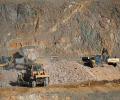
Nine workers were killed in an attack by militants on a copper and gold mine site in Pakistan's Balochistan province.

The Shiromani Akali Dal (SAD) has announced it will contest the upcoming elections to 102 nagar councils and nine municipal corporations on the party symbol. The decision was made at a meeting presided over by party president Sukhbir Singh Badal. The party also addressed concerns about the anti-sacrilege law and the law and order situation in Punjab.

A six-year-old girl was allegedly killed by her father on a train at Silanibari station in Assam's Lakhimpur district. The father has been arrested, and an investigation is underway to determine the motive.

Aam Aadmi Party MP Sanjay Singh has accused the BJP of orchestrating bomb blasts in Amritsar and Jalandhar to destabilise Punjab ahead of elections, a claim strongly refuted by the BJP.

West Bengal Chief Minister Suvendu Adhikari announced that the state government will introduce a new recruitment policy in the next Budget session to address irregularities and scams that occurred during the previous Trinamool Congress government.

Two explosions near security establishments in Punjab have triggered panic and condemnation from opposition parties, who allege efforts to destabilise the state. The blasts occurred in Jalandhar and Amritsar, with investigations underway. No injuries were reported.
Punjab Chief Minister Bhagwant Mann has accused the BJP of orchestrating the recent blasts in Amritsar and Jalandhar to create an atmosphere of fear ahead of upcoming assembly elections. Mann alleges the BJP seeks to incite violence and intimidate the public to gain votes, a tactic he claims they employ in every state where they contest elections.

A humanoid robot named 'Flash,' developed by Shenzhen Honor Smart Technology, achieved a record-breaking time of 50 minutes and 26 seconds in the Beijing E-Town half-marathon, surpassing the human world record in autonomous navigation.

Punjab Finance Minister Harpal Singh Cheema has condemned the recent blasts in Amritsar and Jalandhar, calling them a deliberate attempt to spread terror and disrupt the state's peace. He accused the BJP of trying to create an atmosphere of fear and division for political gains ahead of elections.

Haryana Chief Minister Nayab Singh Saini criticised Punjab Chief Minister Bhagwant Mann for blaming the BJP for recent blasts in Punjab, accusing Mann of losing his mental balance and making irresponsible statements.
Punjab Chief Minister Bhagwant Mann has accused the BJP of orchestrating recent blasts in Amritsar and Jalandhar as part of their strategy for the upcoming assembly elections in Punjab, alleging the party seeks to create an atmosphere of fear to influence voters.

Punjab is on high alert following two explosions in Amritsar and Jalandhar. Police suspect the involvement of Pakistan's ISI in the Amritsar blast, while the Khalistan Liberation Army (KLF) has claimed responsibility for the Jalandhar explosion. Investigations are underway.
BJP leader Tarun Chugh has served a legal notice to Punjab CM Bhagwant Mann for linking the BJP to recent blasts, demanding proof or resignation.

A scooter fire near BSF Chowk in Jalandhar caused panic, with locals reporting a blast-like sound. Police are investigating the incident, while opposition parties criticise the AAP government over security concerns.

'India is often skipping legacy cycles and moving directly to advanced AI-driven operations.'
West Bengal Chief Minister Suvendu Adhikari has announced a new border security initiative, including land transfer to the BSF and a 'detect, delete and deport' policy targeting infiltrators.
The Punjab BJP has called for a sedition case against Chief Minister Bhagwant Mann for blaming the party for recent blasts in the state, alleging his remarks could be used by Pakistan to defend against accusations of sponsoring terrorism.

The Beijing summit may have reduced immediate diplomatic uncertainty, but it did not resolve the deeper structural contest between the United States and China. That contest appears likely to define the coming decade, notes Varun Arya.
A political row has erupted over the twin blasts in Punjab, with Chief Minister Bhagwant Mann accusing the BJP of trying to create fear ahead of next year's assembly elections. The BJP has hit back, terming the remarks condemnable and alleging that Mann ignored preliminary investigation findings pointing towards possible ISI involvement.
Punjab Chief Minister Bhagwant Mann has accused the BJP of orchestrating recent blasts in the state, alleging it's part of their strategy for the upcoming assembly elections. The BJP has strongly refuted these claims, demanding proof or Mann's resignation, while the state DGP suggests Pakistani ISI involvement.
Punjab Chief Minister Bhagwant Mann has accused the BJP of attempting to destabilise the state and create an atmosphere of fear ahead of upcoming elections, following twin blasts in Amritsar and Jalandhar.

Opposition parties have criticised the AAP government in Punjab following twin blasts in Jalandhar and Amritsar, citing a breakdown in law and order and intelligence systems. The blasts have sparked a political blame game, with accusations flying between the AAP and BJP.

Experts at the Mosambi Climate Conference (MC2) emphasized the importance of incorporating digital architecture into the energy ecosystem for achieving significant climate transformation.
Multiple terror attacks in Pakistan's Khyber Pakhtunkhwa province during Ramazan have resulted in the deaths of security personnel, while security forces in Balochistan have killed several rebels in response.

Sam Altman is wagering on GPT5 as a leap towards AGI -- smarter, more accurate and less flattering -- but admits the AI still lacks selflearning.
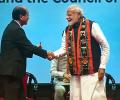
Nagaland Chief Minister Neiphiu Rio has called for strengthening Naga unity across political, cultural and social spheres, emphasising the importance of preserving collective identity.
The Open Quantum Institute, a joint initiative by GESDA and CERN, aims to ensure that quantum computing is accessible to all when it becomes widely available, fostering global collaboration and capacity building.

The Arunachal Olympic Association (AOA) has submitted a proposal to the Indian Olympic Association (IOA) to host the 4th North East Games in 2026, aiming to boost sports development in the region.
The Open Quantum Institute (OQI), a joint initiative by Geneva Science and Diplomacy Anticipator (GESDA) and CERN, aims to ensure equitable access to quantum computing when it becomes widely available, fostering international cooperation and addressing societal implications.

Top female executives are calling for corporate India to redesign workplace systems to support women's advancement into leadership roles in the technology sector, particularly in emerging fields like artificial intelligence.

A top Swiss official has emphasised the growing importance of science and technology in international affairs, leading Switzerland to prioritise anticipatory science diplomacy in its foreign policy. Collaboration with India reflects a shared vision between two global innovation leaders.

'4 lakh to 5 lakh people graduating in computer science getting jobs in software companies will not happen.'

BJP leader Mithun Chakraborty has criticised the West Bengal government over high fuel taxes and alleged security lapses, particularly concerning women's safety and border control.

The Arunachal Pradesh Legislative Assembly has strongly condemned racial discrimination against people from the Northeast and urged the central government to enact a stringent anti-racism law.

Indian security agencies have arrested seven foreign nationals, including a US security analyst and six Ukrainians, for allegedly entering India illegally from Myanmar and suspected of training insurgent groups. The arrests have raised concerns about security vulnerabilities along the India-Myanmar border and triggered diplomatic friction.
